
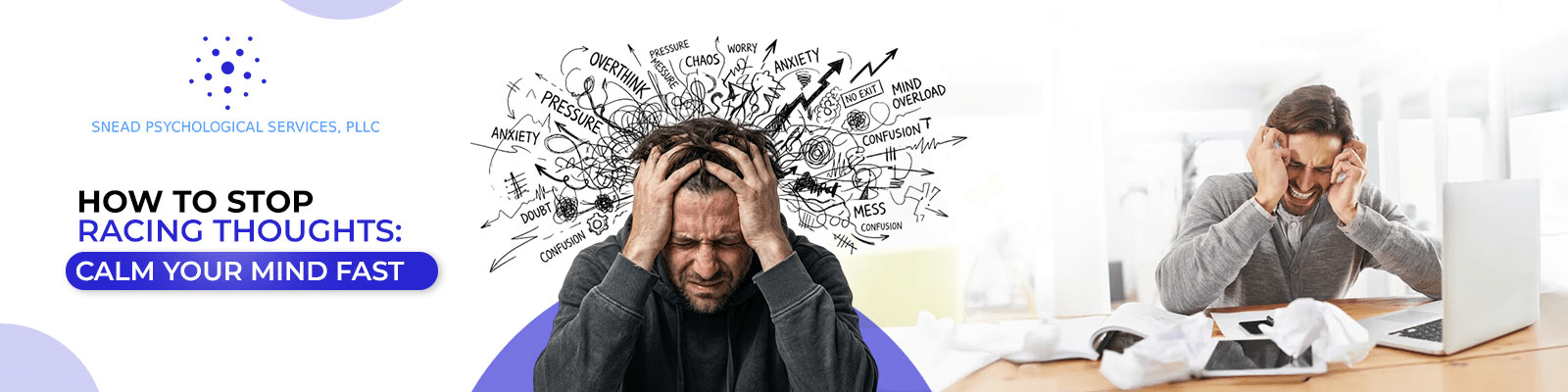
Do you often crawl into bed feeling exhausted, only to find your mind still racing? From daily conversations to unfinished to-do lists and upcoming projects, every thought seems to pile on and make you feel more anxious.
Over time, these feelings can start to affect your life, focus, performance, relationships, and ability to rest. If this sounds familiar, you are not alone.
These are known as racing thoughts. They often show up during stressful or emotionally intense moments. They move quickly, repeat themselves, and can feel overwhelming. Racing thoughts are closely linked to anxiety and emotional distress, and they can also contribute to trouble sleeping.
If you have been struggling with this constant mental noise and want to regain a sense of calm, you are in the right place.
In this blog, we will explore what racing thoughts really are, why they happen, and most importantly, how to stop racing thoughts and help your mind settle down.
What Are Racing Thoughts?
Racing thoughts are rapid, uncontrollable streams of thinking that keep your mind active and overloaded. These thoughts can feel disruptive, intense, and hard to escape. It can feel like several radio stations are playing at once, making it difficult for your brain to slow down.
These thoughts may revolve around work, school, relationships, health, or a mix of many things at once. Sometimes they stay focused on one issue, and other times they jump quickly between different topics. Either way, they can increase anxiety, create emotional discomfort, and make it harder to concentrate.
Anyone can experience racing thoughts during periods of stress or pressure. They can also happen after consuming stimulants like caffeine. Racing thoughts are especially common in people dealing with insomnia, ADHD, bipolar disorder, anxiety, or chronic stress.
Common signs of racing thoughts include:
- Your mind feels like it is moving too fast.
- Slowing your thoughts down feels nearly impossible.
- It feels hard to mentally “shut off.”
- Focusing on tasks becomes difficult.
- You keep replaying a problem that feels serious.
- You dwell on embarrassing or upsetting moments.
- Your thoughts jump from one topic to another within seconds.
- You have trouble sleeping because your mind will not slow down.
- You keep imagining worst-case scenarios.
What Causes a Racing Mind?
Now that you know what racing thoughts are, it helps to look at what causes them. In many cases, a racing mind develops in response to ongoing stress, emotional overload, or mental overstimulation.
Sometimes the mind becomes so used to staying active that it struggles to slow down, even during quiet moments or rest. When your brain stays on high alert for too long, racing thoughts can become more frequent and harder to control.
That is why understanding the root cause matters. When you know what is driving your thoughts, it becomes easier to choose strategies that actually help.
Below are some common causes of racing thoughts, both during the day and at night:
1. Stress and Daily Pressure
One of the most common triggers of a racing mind is chronic stress. When you are constantly managing deadlines, responsibilities, conflicts, or pressure, your brain can remain stuck in a state of high alert.
This makes it hard for your mind to switch off, even when your body is ready to rest. In many cases, the brain enters a fight-or-flight state and starts reacting as if every situation is urgent or threatening. Over time, this constant mental strain can lead to scattered, fast-moving thoughts.
2. Anxiety
Anxiety is one of the biggest causes of racing thoughts. When you feel anxious, your mind starts scanning for possible problems, risks, or uncertainties.
You may replay situations over and over, trying to figure out what went wrong or what might happen next. A single worry can quickly spiral into something much bigger. This is why racing thoughts and anxiety often happen together, especially during quiet moments when there are fewer distractions.
3. Lifestyle Choices
Certain lifestyle habits can also make racing thoughts worse. Irregular sleep, too much caffeine, constant screen time, and ongoing digital stimulation can keep your brain in an activated state.
When your nervous system does not get enough rest, your thoughts may continue running even when your body is ready to relax. Over time, this can make it harder to mentally slow down.
4. Emotional Overload
Unprocessed emotions such as guilt, sadness, anger, frustration, or grief can fuel a racing mind. When emotions build up without being expressed or worked through, the brain may keep returning to the same thoughts in an attempt to make sense of them.
This mental replay can become repetitive and exhausting. If the emotional issue is not resolved, the cycle may continue.
5. Mental Health Factors
Mental health conditions and other underlying factors can also contribute to a racing mind. At the same time, having racing thoughts does not automatically mean you have a disorder. In many cases, it simply means your mind is overwhelmed and struggling to regulate itself.
Some mental health-related concerns that may contribute to racing thoughts include:
- ADHD – In adults, ADHD can show up as mental restlessness, with thoughts jumping quickly from one topic to another.
- Obsessive-Compulsive Disorder – OCD may involve repetitive, intrusive thoughts that loop over and over, sometimes leading to compulsive behaviors meant to reduce distress.
- Bipolar Disorder – Racing thoughts are a common symptom during manic or hypomanic episodes, where the mind may move quickly from idea to idea.
- Post-Traumatic Stress Disorder (PTSD) – Trauma survivors may replay painful memories, intrusive thoughts, or distressing mental images connected to what they experienced.
Racing Thoughts and Anxiety: What’s the Connection?
As you think about what causes a racing mind, one issue probably stands out: anxiety. Racing thoughts and anxiety are closely connected, and they often feed into each other in a way that feels hard to stop.
People who live with anxiety, generalized anxiety disorder (GAD), panic disorder, or chronic stress often experience racing thoughts as part of their daily life. When your mind is anxious, it becomes more alert to possible threats or problems.
It may go into fight-or-flight mode even when there is no immediate danger. This increased alertness can speed up your thoughts and create an ongoing loop of worry. You may find yourself running through what-if scenarios, second-guessing yourself, or mentally preparing for the worst.
Here are a few key ways racing thoughts and anxiety are connected:
1. Constant Worry and Overthinking
Anxiety causes the mind to fixate on worries. You may keep thinking about unfinished tasks, what could go wrong, or how a situation might turn out badly. Instead of resolving the thought, your brain keeps circling back to it.
This creates what many people describe as a mental hamster wheel. The mind struggles to slow down or move on.
2. Heightened Stress Response
Racing thoughts often reflect a state of mental hyperarousal. When your body is stressed or anxious, it stays alert and reactive.
This makes your thoughts move faster. Your brain believes it is protecting you from harm by scanning for danger. Over time, this ongoing activation makes it harder to relax mentally.
3. Physical and Mental Exhaustion
The impact of racing thoughts goes beyond thinking. They can interfere with sleep, reduce concentration, and leave you feeling mentally drained.
That exhaustion can then make anxiety even worse. The result is a cycle where racing thoughts increase anxiety, and anxiety makes the racing thoughts more intense.
How to Stop Racing Thoughts Instantly?
Everyone has moments when their mind suddenly feels out of control. You may become stuck on one thought or bounce rapidly between many unrelated thoughts.
Racing thoughts often create a sense of urgency and make it hard to feel present. The difficult part is that the more you try to force them to stop, the more persistent they can become.
That is why forcing yourself usually does not help. A better approach is to calm your nervous system, redirect your attention, and help your brain feel safe again.
Here are some practical ways to interrupt racing thoughts in the moment:
1. Use Controlled Breathing
One of the fastest ways to calm your mind is to slow your breathing. When your thoughts race, your body often reacts with shallow or rapid breaths.
This can make anxiety and panic worse. Slowing your breath sends a signal to your nervous system that it is safe to relax. A simple method is to inhale for 4 seconds, hold for 4 seconds, and exhale for 6 seconds.
As you focus on your breathing, your mind begins to shift away from the overwhelming thoughts. This creates a pause and gives your brain a chance to slow down.
2. Ground Yourself in the Present Moment
Racing thoughts often pull your attention into the future or back into the past. Grounding techniques help bring you back to the present.
One helpful method is the 5-4-3-2-1 grounding exercise, which uses your senses to anchor you in what is happening around you. By shifting your focus from internal thoughts to external surroundings, you interrupt the cycle of overthinking.
3. Write Down Your Thoughts
When your thoughts are racing, your brain may feel like it is trying to hold onto too much at once. Writing things down can help reduce that pressure.
You do not need to organize or edit what you write. A simple brain dump into a notebook or phone note can help clear mental clutter. Once your thoughts are out of your head and onto paper, they often feel less urgent and easier to manage.
4. Shift Your Focus
Trying to force yourself not to think rarely works. It is often more helpful to gently redirect your attention toward a simple activity.
Taking a short walk, washing your face, stretching, or organizing a small space can help break the cycle. These small actions give your brain something else to focus on and can reduce the intensity of racing thoughts.
5. Acknowledge Your Thoughts
Another helpful strategy is to acknowledge your thoughts instead of fighting with them. Racing thoughts often feel more intense when they seem completely out of control.
Taking a moment to notice what you are thinking without judging it can reduce the pressure. Instead of getting caught up in each thought, you begin observing it. This small shift can make your thoughts feel less overwhelming.
How to Stop Racing Thoughts at Night?
For many people, racing thoughts become strongest at night. When things get quiet, the mind often fills the silence with worries, regrets, plans, or worst-case scenarios.
You may replay an awkward conversation, worry about the next day, or lie awake trying to solve problems that do not have immediate answers. This can lead to nighttime anxiety and make falling asleep much harder.
The effects often continue into the next day, leaving you tired, irritable, foggy, and emotionally drained.
The goal at night is not to force sleep. It is to create the conditions that help your mind and body settle.
Here are a few strategies that can help calm racing thoughts before bed:
1. Create a Consistent Wind-Down Routine
Your brain needs a signal that it is time to rest. Without that cue, it may continue operating as if the day is still going.
A simple bedtime routine such as dimming the lights, reading something calming, listening to soft music, or taking a warm shower can help your mind slow down. Try to avoid stimulating habits like doomscrolling, intense content, or stressful conversations before bed.
2. Maintain a Journal Before Bed
Nighttime racing thoughts often come from unfinished mental business. Your brain may be trying to hold onto reminders, worries, or loose ends.
Writing these things down before bed can create a sense of closure. You might jot down tasks for tomorrow, worries you want to revisit later, or anything that feels unfinished. This helps reassure your brain that it does not have to keep holding everything overnight.
3. Practice Relaxation Techniques
Relaxation exercises can calm both your body and mind before sleep. Deep breathing, gentle stretching, meditation, progressive muscle relaxation, or calming yoga can help lower tension and reduce mental noise.
These techniques help move your body out of an alert state and into a more restful one.
4. Avoid Forcing Yourself to Sleep
Trying hard to make yourself fall asleep often increases frustration. Watching the clock and worrying about how little sleep you are getting can make your mind even more active.
If you cannot fall asleep, it is often better to get out of bed for a short time and do something calm in dim light, such as reading or sitting quietly. This can help reset your mind rather than reinforcing the struggle.
5. Limit Mental and Physical Stimulation
What you do before bedtime affects how your mind functions at night. Caffeine, intense exercise too late in the evening, conflict, heavy screen use, and overstimulating content can all make racing thoughts worse.
Creating a calm evening environment can help your mind settle more naturally.
How to Stop Racing Thoughts and Anxiety Together?
Racing thoughts and anxiety often feed off each other. When anxiety increases, the mind becomes more active and scans for danger, problems, or uncertainty.
That creates even more thoughts, which then make anxiety worse. Trying to suppress these thoughts often backfires because the mind interprets resistance as a sign that something is wrong.
A more effective approach is to change how you respond to your thoughts. When you do that, both the thoughts and the anxiety often begin to lose intensity.
Here are some helpful strategies:
1. Permit Yourself to Experience the Thoughts
Racing thoughts often feel worse when you panic about having them. Trying to get rid of them immediately can increase your distress.
Instead, remind yourself that racing thoughts are a temporary response to stress. They may be uncomfortable, but they are not dangerous. Allowing the thoughts to be there without judging them can reduce the sense of threat.
2. Practice Mindfulness
Mindfulness helps you step out of the overthinking cycle and come back to the present moment. A simple way to begin is by focusing on your breathing, your body, or the sounds around you.
The goal is not to make every thought disappear. It is to notice thoughts without getting pulled into them. Over time, mindfulness can help train your brain to respond to stress with more awareness and less panic.
3. Distract Your Mind Gently
When your thoughts begin looping, a healthy distraction can help interrupt the cycle. Read something light, listen to calming music, draw, take a walk, or do a simple activity with your hands.
The point is not to avoid your thoughts completely. It is to give your brain a break from constant repetition.
4. Be Physically Active
Movement is a powerful tool for managing anxiety and racing thoughts. Physical activity helps release tension, uses nervous energy, and gives your mind another focus.
Even short bursts of movement such as walking, stretching, doing chores, or a few jumping jacks can make a difference.
5. Schedule Worry Time
It may sound unusual, but setting aside time specifically for worry can help reduce racing thoughts. If anxious thoughts show up throughout the day, remind yourself that you will think about them later during your scheduled worry time.
Then, at that time, give yourself space to write or think through what is bothering you. This can help your brain feel heard and reduce the urge to keep bringing worries up all day or all night.
Racing Thoughts Treatment Options
Now that you know how to reduce racing thoughts in the moment, you may wonder whether there are treatment options. The answer is yes.
Occasional racing thoughts are a normal response to stress. But when they become frequent, intense, or disruptive, professional support can help.
A mental health professional can help you identify the root cause and find treatment strategies that fit your needs. They can also help determine whether the racing thoughts are related to anxiety, trauma, ADHD, mood symptoms, or another concern.
Some effective treatment options include:
1. Cognitive Behavioral Therapy (CBT)
CBT is one of the most effective treatments for racing thoughts and anxiety. It helps you identify unhelpful thought patterns, challenge distorted thinking, and replace it with more balanced responses.
You also learn how to recognize triggers and respond to them in healthier ways.
2. Mindfulness-Based Therapies
Mindfulness-based approaches such as Acceptance and Commitment Therapy (ACT) can help you become more aware of your thoughts without reacting to them automatically.
Instead of trying to stop thoughts completely, you learn to notice them, accept their presence, and let them pass with less struggle. These therapies often include breathing exercises, grounding, and values-based coping strategies.
3. Medication
In some cases, medication may be recommended, especially if racing thoughts are severe or linked to conditions such as anxiety disorders, mood disorders, or ADHD.
Medication is not the right fit for everyone, but for some people it can reduce symptoms and make other coping strategies easier to use. A qualified healthcare provider can help determine whether medication makes sense for your situation.
4. Lifestyle Changes
Daily habits have a major impact on how your mind handles stress and stimulation. Lifestyle changes can help reduce the frequency and intensity of racing thoughts.
Helpful habits may include:
- Maintaining a consistent sleep schedule
- Reducing caffeine and screen time
- Eating balanced meals and staying hydrated
- Getting regular physical activity
- Practicing breathing exercises, meditation, or yoga
5. Support Systems
Talking to someone you trust can help relieve mental pressure. Whether it is a friend, family member, support group, or therapist, having a safe place to talk can make a meaningful difference.
Feeling supported can help you feel less alone and more capable of managing what you are experiencing.
When to Seek Help?
Living with racing thoughts and anxiety can be exhausting. If these symptoms become frequent, intense, or start interfering with your daily life, it may be time to seek professional support.
Lifestyle changes can help, but there are times when therapy or additional care is needed to restore a sense of balance.
You should consider seeking help if:
- Racing thoughts interfere with daily activities
- You have trouble focusing on work, school, or routine tasks
- Overthinking is regularly disrupting your sleep
- You feel anxious most of the time
- You struggle to calm down or feel restless often
- You feel emotionally exhausted or mentally drained
Calm Your Racing Thoughts and Anxiety with Guidance From Snead Psychological Services
How do you stop racing thoughts? It is a common question for people who feel overwhelmed by constant mental noise during stressful moments. Even one repetitive thought can affect your focus, sleep, and overall quality of life.
The good news is that with the right strategies and support, you can gradually regain control over your thoughts and reduce anxiety. One of the best steps you can take is reaching out for professional help.
At Snead Psychological Services, we are committed to supporting individuals dealing with racing thoughts and anxiety through evidence-based care. Our expert, Dr. Alex Snead, provides a safe, supportive, and nonjudgmental space where clients can openly discuss their concerns.
Whether you are wondering why your mind races at night or looking for ways to stop racing thoughts and anxiety, we offer clear guidance and personalized treatment strategies based on your needs.
If racing thoughts are affecting your daily life, do not wait for things to get worse.
Reach out to Snead Psychological Services today and take the first step toward a calmer, more grounded mind.
FAQs:
1. What are racing thoughts a symptom of?
Racing thoughts are often a symptom of stress, anxiety, emotional overload, or sleep problems. They may also occur alongside ADHD, bipolar disorder, trauma-related symptoms, or other mental health concerns.
2. Can anxiety cause racing thoughts?
Yes. Anxiety is one of the most common causes of racing thoughts. When you feel anxious, your brain becomes more alert and starts scanning for threats, which can lead to a rapid flow of worries and what-if scenarios.
3. What is the fastest way to calm racing thoughts?
One of the fastest ways to calm racing thoughts is to interrupt the cycle with controlled breathing or grounding techniques. Slow breathing and sensory awareness can help reduce mental overload and bring your attention back to the present moment.
4. Are racing thoughts normal?
Yes. Occasional racing thoughts are a normal response to stress or emotional situations. However, if they happen often or begin affecting your sleep, work, or relationships, it may be helpful to seek support.
5. Are racing thoughts a sign of an anxiety disorder?
They can be. Racing thoughts are commonly associated with anxiety disorders, but they can also happen for many other reasons. A mental health professional can help determine the cause and recommend the best treatment approach.
